|
||||||||||||||||||||||||||||||||||||||||||||||||||||||||||||||||||||||||||||||||||||||||||||||||||||||||||||||||||||||||||||||||||||||||||||||||||||||||||||||||||||||||||||||||||||||||||||||||||||||||||||||||||||||||||||||||||||||||||||||||||||||||||||||||||||||||||||||||||||||||||||||||||||||||||||||||||||||||||||||||||||||||||||||
What`s a Whitey Dob and why should I buy one? The "Whitey Dob" is a series of extremely low priced "Newtonian reflector" telescopes, of 3 different apertures. Whitey Dobs are mounted on a simple, robust and easy to use "Dobsonian" (or "Dob") alt-azimuth type mount, named a "Dob" after its creator the American astronomy populizer John Dobson. All Whitey Dobs are made to highly precise optical, mechanical and usability standards, and the unprecedented low price tag is a major benefit that let`s you get up close and personal with our universe with minimal strain on finances. The perfect gift for your budding amateur astronomer, or for a beginning star gazer of any age wanting a first hand view of "what`s up there", the Whitey Dob 15 telescope is a serious observing instrument that brings the universe directly to you at amazingly low cost.
Three sizes of Whitey Dob, and their prices Whitey Dob are available in four apertures and are priced at 36,800 yen for the Whitey Dob 15, 49,800 yen for the Whitey Dob 20, 79,800 yen for the Whitey Dob 25 and 109,800 yen for the Whitey Dob 30cm. Each telescope is sold as a complete unit that includes all the necessary parts and accesories you need to begin observing TONIGHT! Included are all applicable taxes and freight fees, for next day delivery to your home, office, or school (although some remote island locations may require an additional day or two for delivery). What about warranties?
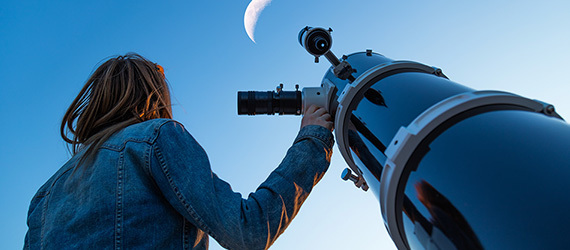
It doesn`t look like a telescope... The image the word "telescope" brings to mind is a skinny white tube on a spindly metal mounting and this is indeed the item sold at Home Centers and Department Stores that target beginning astronomers. The "typical" telescope utilizes a lens at the front of the tube that refracts light to a sharp point the bottom of the tube, where the observer inserts a second lens called an "eyepiece, and actually views the image. The Whitey Dob, however, uses a a reflective "primary" mirror located at the bottom of the tube . This mirror focuses and then bounces a star`s light back to the top of the tube, where another small "secondary" mirror placed at a 45 degree angle reflects this light out the side of the tube, where the observer actually observes the image. This mirror design was invented by Isaac Newton back in the 1700`s and remains pretty much unchanged in the 21st century. Why use a mirror instead of lens? While standard "refractor" telescopes using lenses are highly popular, offer excellent views and are quite viable telescopes, using a mirror instead of a lens offers one very important benefit to astronomers: Large aperture at low cost. Why is aperture important? Objects in space are so unimaginably distant from us that their light is quite faint and diffuse. Large apertures naturally capture a bigger swath of light from an object than a smaller one, and focus this light into a small spot, in exactly the same way that a magnifying lens will concentrate the sun`s light. A bigger aperture multiplies the apparent brightness of an object as compared to a smaller one, allowing us to view so much more of its details. Consider that the 15cm aperture Whitey Dob 15 captures as much light as almost 460 human eyes (aperture about 7mm), letting you see many, many dozens of times deeper into the night sky than with the unaided eye. The benefits of large aperture are great, and Whitey Dob provides this aperture at an unbeatable and very attactive price. Then why not use a large aperture lens? Manufacturing large aperture lenses is actually a daunting and expensive process, with refractor telescopes of aperture similar to the Whitey Dob 15 costing several to dozens of times more than its modest price. But mirror making is not burdened by such heavy constraints. On the contrary, mirror manufacturing in the 21st century is a mass production process where high quality, large aperture optics are now produced in large lots at low cost, and this cost savings is passed on to the user. Thanks to the larger aperture mirrors now available
to amateur astronomers at low cost, average amateur telescopes
of today are now able to view celestial objects that were quite
invisible even to well-heeled observers of as little as 20-30
years ago. Imagine what Galileo would have seen had he a telescope
with the capabilities of the Whitey Dob 15, a telescope unimaginable
back in the 1600`s. What about magnification ("power")? Department store and mail order telescope ads often exhort the high "600X" etc magnifications available when you buy one of their telescopes. From a marketing perspective, this feature attempts to give a handle to consumers trying to come to a buying decision for their first telescope. Unfortunately, this specification is a bit of misinformation that is actually not at all helpful to sky observers. Why is that? Because, even thought it is easy enough to magnify a celestial object through a given telescope to 600X its apparent size, this does not mean that that object is now 600 times more fun to view! A certain degree of magnification is necessary when viewing celestial objects. But the darkside of this situation is that excessive magnification also increases atmospheric turbulence, optical and mechanical errors in the telescope`s optics, makes very apparent any shakiness in the mountings, and tends to result in ugly blobs of light bouncing around in the image. High magnification also narrows the telscope`s field of view, making placing objects into this tiny view window a major headache. Better to stick with lower magnifications. Most amateur astonomers use mainly lower magnifications of 50X-200X range. This level of power results in the most pleasingly clear views of planets and the moon. Faint galaxies and nebula are surprisingly beautiful and detailed at magnifications as low as 30X-50X. When sky stability permits, increasing mangification to several hundred power for close ups of the moon and planets is always a treat. Unfortunately, the nights that turbulent sky conditions allow clear views at such high magnifications are relatively rare. Again, better to stick with lower magnifications. As mentioned previously, satisfying astronomical observing depends first on aperture and then on magnification second. Whitey Dob`s large aperture provides comparitively high object brightness (as compared to a "spindly white tube")and this brightness magnified 40X and 150X will result in a great deal of viewing fun. Although it is also true that most observers will increase their eyepiece selections over time to encompassa a wider range of magnifications, the two eyepieces included as standard with each Whitey Dob provide 48X and 120X, more than adequate to begin your astronomical explorations. Tell me more about all three Whitey Dobs and which one is best for me Here are some guidelines: Whitey Dob 15 The light gathering power of Whitey Dob 15 is the equivalent of about 459 times that of the avergage human eye. The Whitey Dob 15 telescope is a 15cm aperture reflector telescope of an F8 focal length." F8 "merely means that the focal length is 8 times the diameter of its primar mirror. In this case, F8 works out to about 120cm (15cm x 8). F8 is considered a rather long focal length whose great benefit to the observer is especially sharp and high contrast views of solar systems objects, namely, the moon, Mercury, Venus, Mars, Jupiter and Saturn (Uranus, Neptune and just kicked out of the planetary club, Pluto, are rather dim, hard to find and hard to see objects). The Whitey Dob 15 is also an excellent telescope for serious (and also fun!) observations of the brighter nebula, such as the spectacular Orion Nebula, star fields in the Milky Way, and large groups of loosely clumped stars called "open clusters". There are plenty of these objects that are easily seen in the northern sky constellations of Cassiopeia and Perseus. For first time telescope buyers, purchasing a telescope as a gift, or for those under budget and/or space constraints, the Whitey Dob 15 is for you. Despite its "can`t go wrong" low cost, Whitey Dob 15 will serve you well with years of satisfying star gazing. At about 6Kg, the Whitey Dob 15 is easily transportable by ladies, teens and older children. The included two eyepieces provide 48X and 120X at the focuser.
Whitey Dob 20 The Whitey Dob 20 telescope is a 20cm aperture reflector telescope of an F6 (120cm) focal length. For observers contemplating deep space observations favoring galaxies and nebulae, with a minor in solar system objects, the Whitey Dob 20 is an excellent choice. The Whitey Dob 20 offers about 1.7 times more light gathering power than the Whitey Dob 15. This works out to about 816 times the light gathering power of the human eye, and will render faint galaxies and nebula with a bit more brightness and definition than the Whitey Dob 15, sky conditions permitting. Observations of solar system objects will be of similar quality. The Whitey Dob 20 is about 2 kg heavier than the Whitey Dob 15. Though still transportable by ladies and teens, it might be a bit heavy for children. The included two eyepieces provide 48X and 120X at the focuser.
Whitey Dob 25 If your interests will tend mainly toward deep sky observations, and much less toward solar system objects, then the Whitey Dob 25 gets the nod. Whitey Dob 25 offers 2.7 times the light gathering power of the Whitey Dob 15 and 1.5 times that of the Whitey Dob 20. This light gathering power works out to the equivalent of almost 1250 times that of the human eye. Galaxies and nebula await!. At 25cm aperture, this telescope is a serious deep sky instrument that has already enjoyed considerable acclaim in the Japanese astronomy community. It will, sky conditions permitting, show you dust lanes and other fine details in galaxies, resolve individual stars inside globular clusters (countless stars clumped into a tightly packed "ball" of stars) and allow you to explore deep within the vastness of intricate nebula. At F4.8, however, views of solar system objects will be slightly less contrasty than the Whitey Dob 15 or the 20. At 13kg, the telescope is a bit bulky and heavy for ladies and teens to carry. The included two eyepieces provide 48X and 120X at the focuser.
Whitey Dob 30 The Whitey Dob 30cm has created a strong buzz in Japan, with multiple sell-outs of inventory over the last year since its introduction. This popularity makes these scopes somewhat hard to keep in stock! A powerful instrument made specifically for observing deep sky objects in great detail. The Whitey Dob 30 offers over 2.2 times the light gathering power of the Whitey Dob 20 and over 1.4 times that of the Whitey Dob 25. This light gathering power works out to the equivalent of the lighty gathered by almost 1840 human eyes, making Messier, NGC and IC and other objects are yours for the taking! Dust lanes and shapes of galaxies, the myriad stars of stars globular clusters, and the uncountable diamonds of pinpoint light in the Milky Way star clusters will truly take one`s breath away. At F5, solar system objects are also sharp and bright. The Whitey Dob 30cm is a BIG telescope, about twice the size, weight and volume of a Whitey Dob 25, and best handled by robust users individually (or by two "normal" observers, like the rest of us ; - )). The included two eyepieces provide 60X and 150X at the focuser. When viewing larger deep space objects or wide star fields in all their glory, this telecope will profit handsomely with the use of optional wide field long focal length (ie; longer than 24mm) 2" eyepieces.
Sky conditions and their effect on observing As you might have guessed, sky conditions will greatly influence your Whitey Dob observing experiences. Night skies flooded with man-made light wash out the already faint to begin with light from the celestial objects, often to the point of making them invisible. If you are not able to take your Whitey Dob to the dark skies of the mountains or the countryside, your viewing will likely be limited to the bright solar system objects from the Moon to Saturn. These objects, fortunately, are not quite as dimmed by city lights as faint deep sky objects, and can be viewed with satisfaction from city backyards and "mansion" verandas. If this describes your situation , we suggest the Whitey Dob 15 as being your best choice in a first telescope. Taking your telescope to a dark sky site (or better yet, living in one!) will show you a whole new universe, one so filled with stars and nebula that it will almost seem you`ve been transported to another planet! To see what astronomy is really all about, by all means make the effort to take your telescope out to the country. City viewing just will not do your telescope`s capabilities (and yourself, the observer) justice. Options Although your Whitey Dob is shipped with everything you need to begin your astronomical observations from your very first day, there are also plenty of optional items available that will enhance your viewing enjoyment. We will be adding especially recommended items to this page in the very near future. These items include the hardware aspects of observing, such as eyepieces and filters, and software items such a planeterium software for your computer, star charts and books. We recommend you use your Whitey Dob for a couple of weeks and get used to all its capabilities before buying additional eyepieces (for higher or lower magnification) or filters (to reduce night time sky glow from pachinko parlors, neon signs, parking lots etc). However, star charts and sky guides are always a welcome addition to an astronomer`s observation arsenal. For astro atlases and guidebooks in Japanese, contact us for further information. In English your best bet for astronomy related guides and charts is, naturally, Amazon.co.jp! Or search the net for online star atlases, many of which are free, yet surprisingly complete. An example of one such program is at: www.skymaps.com
What happens when my Whitey Dob arrives? 1) Your Whitey Dob will arrive in two boxes. One will contain the complete telescope tube assembly (the optical tube, with all mirrors and parts installed and assembled). The second box contains the "Dobsonian" mount, which requires simple assembly, similar to putting together a piece of modular furniture. Yes, you have to assemble the mount..... However, don`t panic! 2) All hardware and tools required for assembly are included with your Whitey Dob, and assembly itself is very straightforward and easy. About 30 minutes is all you will need to complete the assembly. A set of very detailed instructions in Japanese is included with your Whitey Dob. For a preview, download this manual here in pdf format. We will also have this manual in English up for download in a few days. 3) Once your "Dobsonian" mount is assembled, place your Whitey Dob tube assembly`s circular altitude bearings onto the pairs of bearing supports attached to the mount`s inner walls. Screw the two clamp handles into the altitude bearings from the outside of the mount, insert one of the two eyepieces included into the focuser and then attach your "finderscope" bracket to the slotted holder near the focuser. 4) Next, let`s align the finderscope to the main telescope. First, point your Whitey Dob at a far away, non moving object such as a telephone pole or antenna (you might notice how hard it is to find this object in the Whitey Dob`s small field of view. But bear with us here.....). 5) This could take a minute but once you do find the object you are looking for, adjust the eyepiece up or down in the focuser by turning the knob on the side, and find the point of best focus. 6) Now, without moving the telescope, look through the "finderscope". Usually, at this point the finderscope is pointing in a direction far removed from that of the main telescope, so you will need to align it now. Do this by turning the two black adjustment screws on the finder bracket. These will adjust the pointing direction the finderscope. 6.1) While zeroing in the pointing accuracy of the finderscope. every now and then, switch between the main and finderscopes, to make sure the scope does not move while doing this adjustment. Continue adjusting the two finder adjustment screws until the finderscope image and the Whitey Dob image line up. You`ve now aligned your finderscope. This necessary work in the beginning makes finding objects from here on out so much easier to view. 6.2) Try it out! Move the scope around and find an object in the finderscope that you want to take a closer look at through Whitey Dob. When you acquire the object, next look thruough the eyepiece inside your focuser. The same object, at higher power and much better definition should be in the field of view (if it is not there, more finderscope adjustment is needed). 7) Next, switch eyepieces and see the same object at either higher or lower magnification (depending on which eyepiece you initially inserted into the focuser). You are now set up to view the heavens! Wait til dark and point your Whitey Dob at the moon ,if it`s up, or at some bright stars. Sweep through the sky and observe the stars that come in and out of view. Switch eyepieces and refocus as necessary. 8) Show the night sky objects to your family and friends. Let people know you have a telescope and you will soon have excited observers lined up for a peek! Happens EVERY time! 9) Get a star chart or a planetarium program for your computer, and find out where objects are in the sky. Learn the shapes and locations of a few of the easier to recognize constellations and get your bearings in the sky. This is the essence of using your telescope. How to order Ordering your Whitey Dob easy 1) Just send us an email or a fax (075-394-2612) telling us which Whitey Dob you would like to order, and your address, which can be written in either Japanese Kanji, or Romanized into the alphabet. 2) Or call us at 075-394-2625 and place your request directly (though phone calls are limited to Japanese language only).
3) Next, transfer payment via wire transfer to our account (pls call or email for details). 4) Upon receipt of your payment, we will send your Whitey Dob to you in either two or three boxes, one containing the optical tube and the second, the base. In the case of the Whitey Dob 30, a third box will contain the 30cm aperture mirror. Delivery is usually next day. 5) If you prefer payment via COD (cash on delivery, or "daibiki"), we will add \500 to your bill and ship same day as your order. Payment is then effected by paying the freight person when he/she delivers your Whitey Dob to your requested shipping address (no need to prepay your order). 6) Unfortunately, we are not able to accept mail order credit card payment at this time. 7) Or drop by and visit our shop in Kyoto, see all three Whitey Dob demos first hand and take your Whitey Dob home with you directly. We should mention that payment via credit card is accepted at our shop. Please downloand a map to our shop in pdf format here. Lastly, Please feel free to contact us with your thoughts, questions. We`ve been helping amateur astronomers in Japan with their observing challenges for nearly two decades and making a difference in their experiences is the very reason we are in business. We look forward to being a part of astronomical experiences too. You will LUV your Whitey Dob - I guarantee it! Kokusai Kohki / Barry Gooley - pres. ![]() Kokusai Kohki (KK Magellan) Ouno Cho 7-7, Kamikatsura, Nishikyo Ku Kyoto 615-8217, JAPAN TEL: 075-394-2625 FAX: 075-394-2612 Email: magellan@kkohki.com (Business hours: Mon thru Fri:10AM to 6PM, Sun: 10PM-6PM, Closed Sat and Japanese National Holidays)
|
||||||||||||||||||||||||||||||||||||||||||||||||||||||||||||||||||||||||||||||||||||||||||||||||||||||||||||||||||||||||||||||||||||||||||||||||||||||||||||||||||||||||||||||||||||||||||||||||||||||||||||||||||||||||||||||||||||||||||||||||||||||||||||||||||||||||||||||||||||||||||||||||||||||||||||||||||||||||||||||||||||||||||||||